Bedouin Traditional Clothing
The term "Bedouin" (from the Arabic "Bedu" - "the desert dwellers") can be used to refer to a range of people. Very loosely it can refer to any nomads of Arabia, the Levant and North Africa. It can be limited to just nomads of Arab decent, or even just those who bred camels. These days those who live a settled life still identify as Bedouin - even though their lifestyle is that of a business man, engineer or soldier.
The following is a rough overview of some traditional clothing. Again keep in mind there is variation geographically and socially.
Bedouin - Women

Bedouin woman (1909)
The basic "dress" is an enormous tob or thobe. Usually in dark blue with light blue bands of decoration and decorated seams.
One version of the tob (the tob 'ob) found especially around Jericho - was more than twice the length of a person and was hitched up to creating three layers and the sleeve used as a veil.
Here is a clip of
a women wrapping a tob'ob from the 1920s.
When cold or wet a sleeveless coat or mantle (aba) is wrapped over the top and occasionally over the head.
Bedouin women in Northern Palestine, Jordon and Syria wore a blue or black thobe or shirsh with long tight sleeves and a long neck opening. Decoration includes embroidery along the seams, above the hem and around the neck or four or five horizontal lines embroidered bands above the hem.
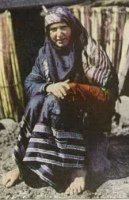
Bedouin woman (1926)
Bedouin women in Southern Palestine wore a similar shaped, but more voluminous, light blue or black dress (thobe) with winged sleeves. These sleeves narrowed by the 1960s. From the 1930s they also included cross stitched embroidery but in a different style to the villagers. The embroidery is usally red for women and blue for unmarried girls. Brightly coloured and patterned dresses (fustan) were worn under the overdresses.
Unmarried women wear a bag like hatta (the underlying fabric is like the men's kufeya but worn without and agal). Married women fold the square into a band and wear it around the head.
Women wear a range of jewellery that represents the family's wealth - but also has perceived protective qualities. For instance triangles (representing hands) or eyes avert the evil eye. Hijab (or hirz) - silver cylinders containing verses of the Koran - protect against accidents and scorpion stings. Jewellery includes necklaces, rings, anklets and bracelets. The anklets and bracelets are often hollow and filled with stones to make noise.
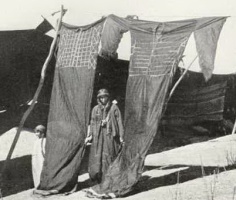
Bedouin big thobes (1937)

Thobe (Kuwait museum)
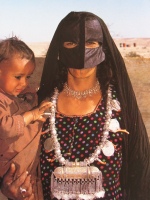
Bedouin necklace
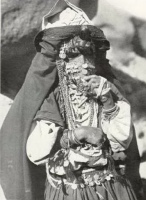
Sinai 1937
Bedouin women in southern Arabia are unveiled. In the north they are veiled with a range of masks. In the Levant they again go unveiled with just their hair covered by dark blue or black veils. The shambar is a tube that encloses the head and neck. In the Sinai desert the burqas are formed by rows of coins.
While elsewhere unmarried Bedouin girls wear hattah like a bag, married women roll it like a headband.

Bedouin in shambar bound by `asbeh Palestine 1926

Bedouin married and unmarried women (1937)

Bedouin burqa Oman 1981

Bedouin burqa Oman 1995

Bedouin burqa Palestine
Bedouin - Men
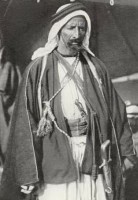
Bedouin man 1937
The basic "dress" is a tob or thobe of (usually) white cotton to the ankles (silk and wool are also traditional; earth colours are also common - and in Oman brighter colours).
The collar on the tob varies by region. In Oman it is round with a button and tassel. Further north the tassel gets dropped. Elsewhere a high collar (like an European clerical collar) is worn.
The tob has large triangular sleeves which are tied back with a cord.
Under this Omani Bedouin wear a sarong. Many other wear sirwal. Around Palestine the legs are bare.
Over the tob a striped kibr open down front with belt and/or shoulder straps is worn. For non-manual workers a redan - with kimono shaped sleeves to ground - reinforces their leisure status.
Over this a sleeveless coat - aba is worn. This is often striped for Bedouins.
Headwear for most Bedouin men is a kufeya held in place with an igal of camel wool. The kufeya is a square of fabric folded into a triangle with a point on each shoulder. The igal can be richly decorated with metallic threads. However, in Oman a turban like maser is worn.
Unlike women, Beduoin men do not wear jewellery - however curved knives (khanja), rifles and ammunition are frequently worn.
.jpg "Bedouin c 1885 by Sebah")
Bedouin (1885)

Kufiya - ghoutra & `iqal. (1923)

(1938)
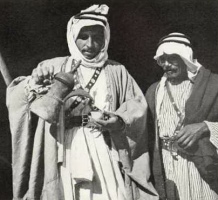
Bedouins and coffee (1937)

Palestine (1926)

Oman (1956)

Oman (c1980)

Khanja
|
References: Anawalt, Kennet, Keohane, National, Tilke, Weir
|
Also see:
Palestinian Clothing
Return to "Middle Eastern Background" page
Return to www.raqs.co.nz
© Copyright 2008
Updated by JEWEL
